
Simplifying complexity: removing friction without adding risk
“Most organisations do not struggle because they lack technology, they struggle because complexity has quietly crept in.”
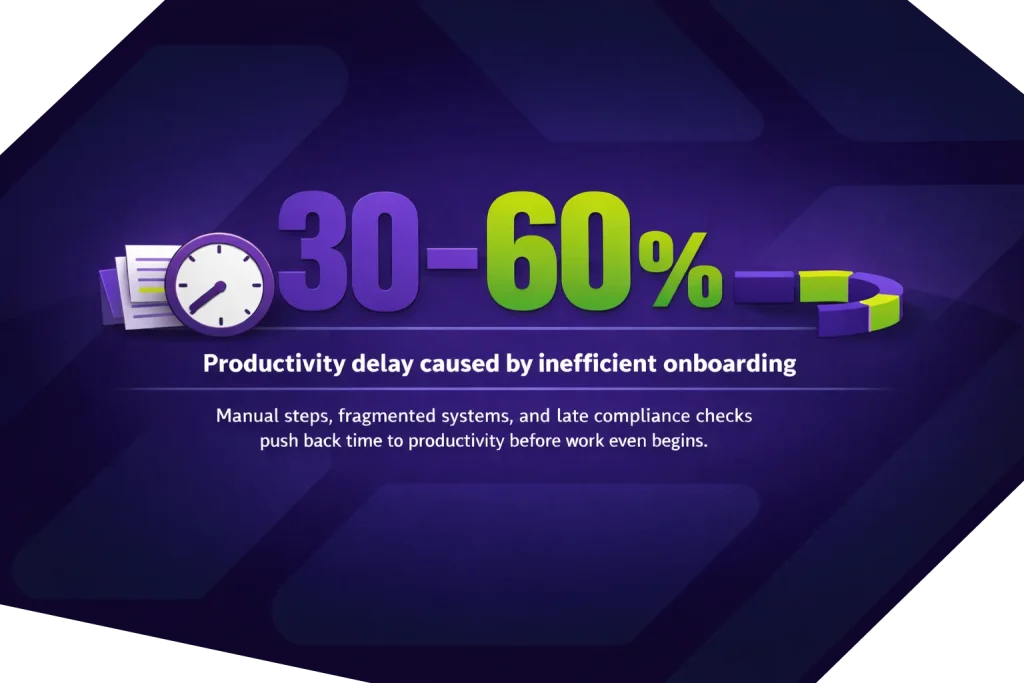
Industry research consistently shows that onboarding and workforce processes are one of the biggest sources of operational drag. Inefficient onboarding can delay productivity by 30 to 60 percent, while manual compliance processes significantly increase the likelihood of errors in regulated environments. At the same time, more than 70 percent of digital transformation initiatives fail to deliver their expected value, most often because they automate poorly defined processes rather than fixing them.
This challenge is not limited to staffing businesses. It affects organisations across healthcare, hospitality, construction, logistics, professional services and enterprise operations. Anywhere people, documents, approvals and compliance intersect, friction tends to build.
Over time, onboarding, compliance and workforce management become layered with workarounds, spreadsheets, inboxes and disconnected tools. Each new system promises speed, but often adds another moving part.
The result is familiar.
Friction increases. Risk creeps in. Automation disappoints.
The good news is that complexity can be reduced without sacrificing control, compliance or visibility. But only if it is tackled in the right order.
How to remove friction from onboarding without adding risk
Friction usually appears where responsibility is unclear.
- Who owns document checks
- Who approves changes
- Which version is correct
- What happens if something is missing
Many organisations try to solve this by digitising existing steps. Paper becomes PDFs. Emails become portals. Spreadsheets become forms. The process looks modern, but the underlying uncertainty remains.
Removing friction safely requires three fundamentals.
Clear ownership
Every step needs a defined owner. Not a team and not a shared inbox, but a role accountable for completion and escalation.
Standardised pathways
There should be one approved way to onboard a worker, supplier or employee for a given scenario. Variations should be intentional, not accidental.
Built-in validation
Risk should be reduced automatically. Required documents, approvals and checks must be enforced by the process itself, not remembered by individuals.
When these are in place, speed increases naturally. People move faster when they trust the system to protect them from mistakes.
Why automation fails without structure
Automation has a reputation problem. Not because the technology is weak, but because it is often applied too early.
Automating an unclear process simply makes confusion happen faster.
Common symptoms include
• Automations breaking when a step is skipped
• Edge cases requiring manual fixes
• Teams bypassing systems to get work done
• Reduced confidence in reporting and audit trails
Structure must come first.
Structure means clearly defined data, consistent workflows and rules that reflect how the organisation actually operates. Once those foundations exist, automation becomes reliable rather than brittle.
In practice, successful automation does three things
• It reduces manual effort without removing oversight
• It enforces consistency at scale
• It creates visibility rather than hiding decisions
Automation should feel invisible to the user, but obvious in the outcomes.
Digitising chaos versus fixing it
There is a critical difference between making something digital and making it better.
Digitising chaos looks like
• Faster forms but the same confusion
• More dashboards but less clarity
• Better tools masking broken processes
Fixing chaos looks like
• Fewer steps, clearly ordered
• Data captured once and reused
• Decisions that are traceable and auditable
• Technology reinforcing good behaviour
Organisations that succeed do not start by asking which tool to buy.
They start by asking which problem they are actually trying to remove.
Only then does technology become an advantage rather than another layer of noise.
A practical way to assess your readiness
Whether you are a staffing business managing high-volume workers or an organisation onboarding employees, contractors or partners, the principles are the same.
Before investing further in automation or workforce technology, it is worth stepping back and assessing readiness.
We have created a short, practical checklist to help teams do exactly that.
Workforce Tech Readiness Audit
A fast, sales-friendly checklist designed to help you
• Identify where friction really comes from
• Spot hidden risk in onboarding and workforce processes
• Understand whether automation will help or hinder
• Prioritise fixes that deliver immediate impact
It is designed to be completed quickly, without technical knowledge, and works equally well for staffing and non-staffing environments.